Monthly Archives: October 2025

Trump’s Gaza Deal: Tactical Victory or Strategic Failure

Donald Trump is back in the Middle East spotlight — not as a candidate or commentator, but as a self-declared peace broker.
He claims to have engineered a breakthrough deal between Israel and Hamas: hostages exchanged, Gaza demilitarized, technocrats in charge, and reconstruction under U.S. oversight.
It’s being sold as decisive. Historic. Final.

It’s none of those things.

Trump’s new Gaza deal is a tactical maneuver posing as a strategic solution — a short-term show of dominance in a conflict that can’t be solved by force or deadlines.

1. The Context: What Trump Is Proposing

Trump’s proposal includes several highly publicized components:

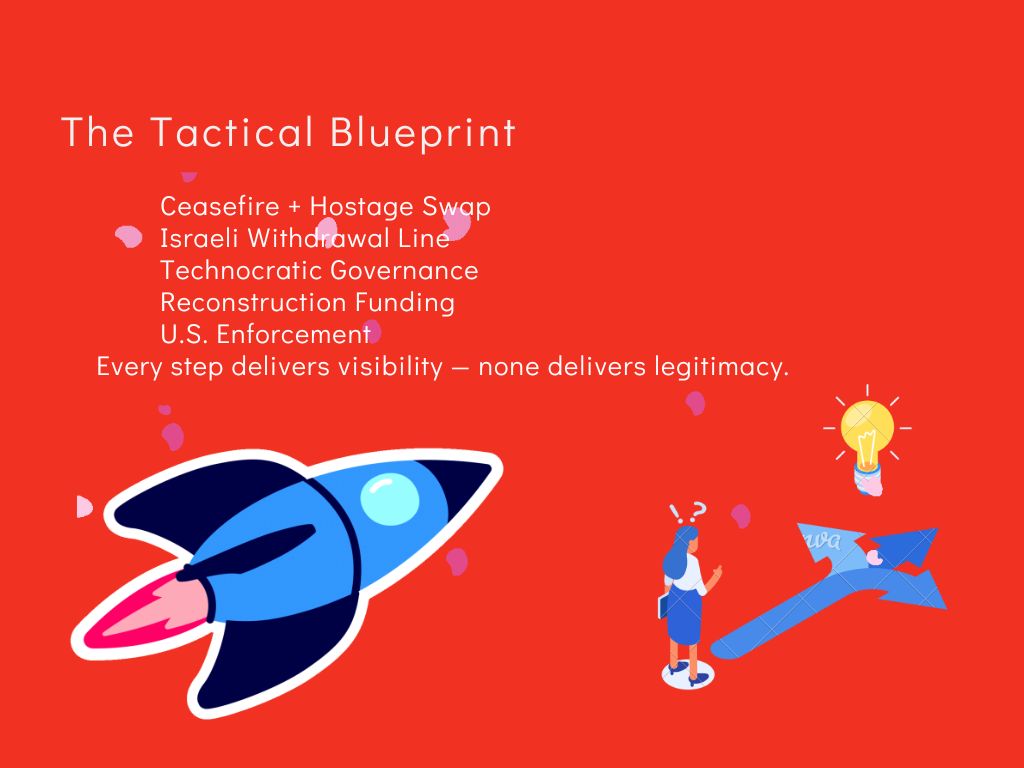
  • Ceasefire-for-hostages formula: Israel commits to a defined “withdrawal line” once Hamas confirms prisoner exchanges.
  • Demilitarization and transitional rule: Hamas is to be replaced by a technocratic administration backed by international guarantees.
  • Reconstruction conditionality: U.S. and Gulf funding tied to compliance.
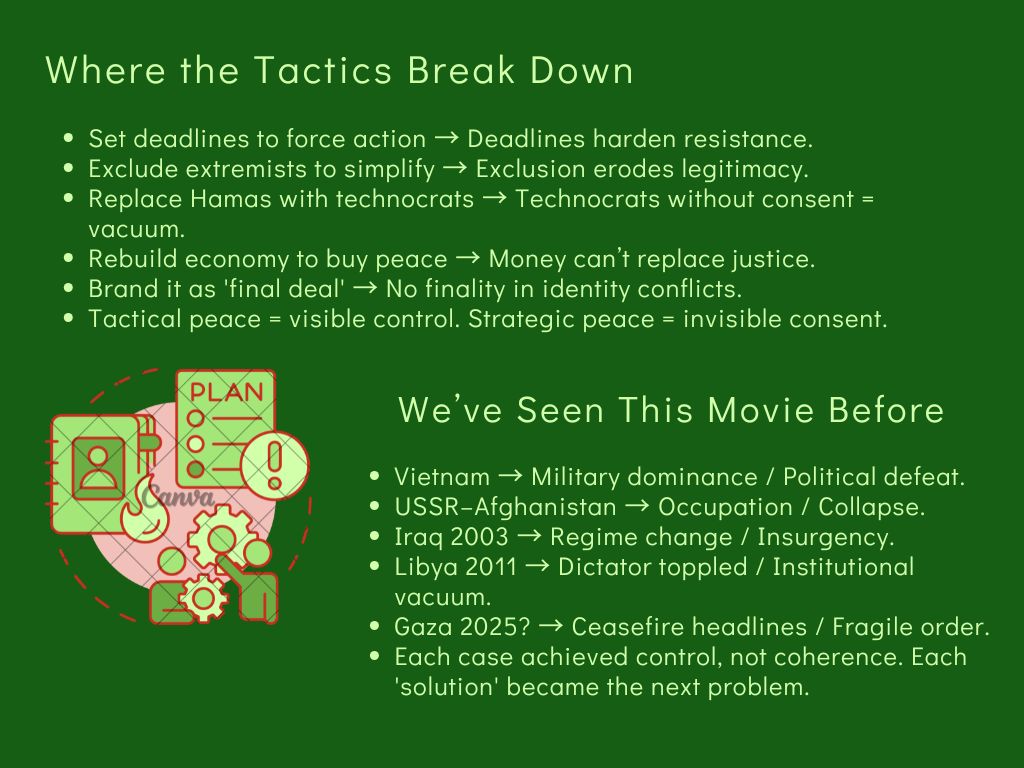
  • Tight deadlines and coercive diplomacy: Accept within days or face “total destruction.”

At first glance, this looks assertive and pragmatic. The logic is transactional: deliver security and humanitarian relief through deal-making efficiency.
But this model assumes that the Gaza conflict is a technical crisis to be managed, not a structural conflict to be transformed.
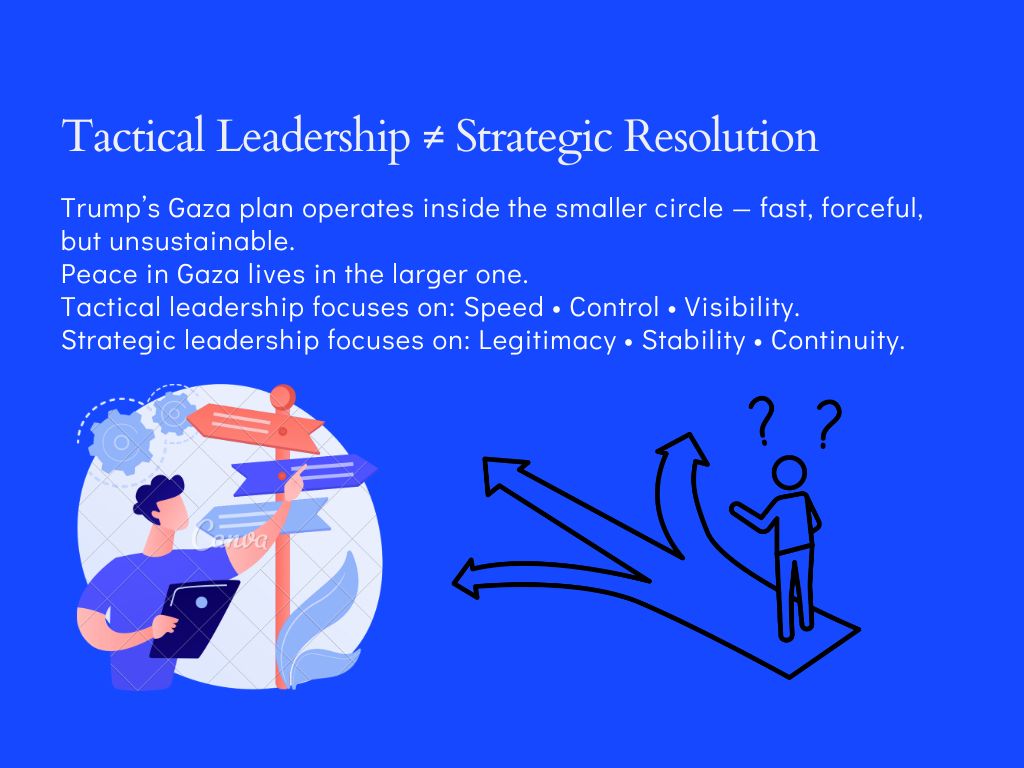
2. The Analytical Problem: Tactics Without Strategy

Trump’s model falls into a recurring pattern of tactical dominance: use leverage to impose compliance and produce an immediate, visible result.
This approach may temporarily silence guns, but it rarely produces enduring political order.
Three fundamental contradictions expose why:

a. Power Without Legitimacy

In every sustainable peace process, legitimacy matters more than leverage.

  • The 1998 Good Friday Agreement in Northern Ireland succeeded because both sides recognized each other’s political legitimacy.
  • Oslo, however flawed, worked temporarily because Israelis and Palestinians co-authored it.

Trump’s deal, by contrast, was drafted almost entirely in Washington. Hamas and most Palestinian political factions were not at the table.
Imposed agreements without shared authorship tend to generate temporary compliance and eventual defiance — the same dynamic that doomed U.S. attempts at nation-building in Iraq and Afghanistan.

Argument: When one side dictates the terms, the other side has no stake in preserving them.
Without legitimacy, enforcement becomes the only governing principle — and enforcement erodes over time.
b. Deadlines and Threats in a System That Operates on Identity

Trump’s ultimatum-driven diplomacy — “accept by Sunday or face annihilation” — assumes that Hamas behaves like a rational actor maximizing short-term gain.
But movements rooted in identity and ideology operate under different incentives: survival, symbolism, and resistance.
Empirical studies of asymmetric conflicts (see Walter, Civil Wars, 2017) show that coercive deadlines in identity-based wars often harden positions rather than soften them.

Argument: Coercive timing may accelerate decision-making, but it decelerates transformation.
Trump’s style achieves speed at the expense of sustainability.

c. Economic Leverage Without Moral Architecture

Trump’s promise of U.S. and Gulf-funded reconstruction mirrors the “Marshall Plan for Gaza” narrative — using capital as peace currency.
But data from World Bank and RAND studies show that reconstruction aid without governance reform merely amplifies dependency and corruption.
In postwar Lebanon, billions in reconstruction funds produced urban growth without institutional integrity; militias simply taxed the recovery.

Argument: Economic relief cannot substitute for justice or political recognition.
Trump’s deal treats reconstruction as compensation, not as restoration of dignity — a distinction that determines whether peace lasts or implodes.

3. The Historical Pattern

Trump’s proposal is not an anomaly. It belongs to a lineage of Western interventions that confuse momentary control with strategic resolution:

CaseShort-term “win”Long-term outcome
Vietnam (1960s-70s)Military dominance; peace accords.Political defeat; loss of legitimacy.
USSR in Afghanistan (1980s)Occupation and puppet governance.Collapse of state and regime.
U.S. in Iraq (2003-)Regime change.Fragmented order, enduring insurgency.
NATO in Libya (2011)Removal of dictatorship.Institutional vacuum, chronic instability.

Each case demonstrates the same sequence: tactical execution → initial control → legitimacy gap → long-term erosion.

Conclusion from evidence: Tactical victories create strategic liabilities when the political system beneath them lacks ownership, justice, and continuity.
4. Trump’s Leadership Pattern: Consistent, Predictable, and Misaligned

Trump’s approach to Gaza is not an outlier — it is an extension of his governing psychology.
He treats politics the way he ran casinos and television shows: as contests with clear winners, visible outcomes, and constant applause.
This produces what political psychologist Jerrold Post calls “transactional narcissism” — leadership driven by the need for dominance and validation, not durability.

The effect on policy is measurable:

  • Short horizon: narrow focus on immediate optics.
  • High volatility: decisions reversed if applause fades.
  • Low predictability: allies uncertain; adversaries exploit inconsistency.

In game theory terms, this is a leader stuck in one-move logic — maximizing the next payoff, not the next generation.

5. The Strategic Lens: What a Real Peace Architecture Requires

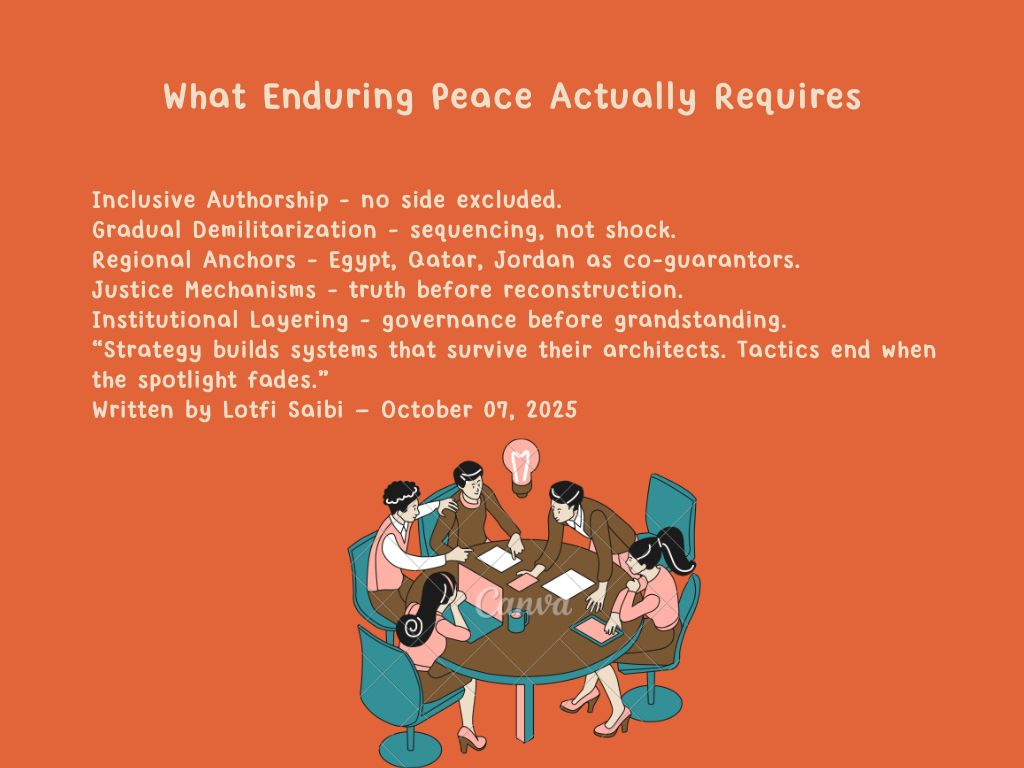
If we evaluate Gaza as a strategic ecosystem rather than a tactical crisis, five prerequisites emerge — all absent from Trump’s plan:

  1. Inclusive authorship: all political currents represented, even adversarial ones.
  2. Gradual demilitarization: sequencing, not shock therapy.
  3. Regional integration: Egypt, Jordan, and Qatar as co-guarantors, not spectators.
  4. Justice mechanisms: credible international or local inquiry into war crimes to anchor accountability.
  5. Institutional layering: security, judiciary, local governance built in tandem — not outsourced to foreign administrators.
These are not idealistic conditions; they are empirical necessities drawn from post-conflict transitions that worked (Bosnia’s Dayton Accords, Colombia’s FARC process).
Each succeeded because they created a system, not a show.

6. Data and Early Indicators

  • Public sentiment: Early polling by Arab Barometer (Sept 2025) shows only 8% of Palestinians trust any U.S.-brokered framework, down from 27% in 2020.
  • Regional diplomacy: Egypt and Qatar have both voiced “conditional support,” signaling skepticism about feasibility.
  • Conflict trendlines: According to UN OCHA data, ceasefire violations in previous U.S.-brokered truces spike within 10–14 days when one side perceives the terms as imposed.

These data points suggest that, even if Trump’s deal produces a temporary lull, the probability of relapse is high unless legitimacy and inclusivity are structurally embedded.

7. Conclusion: Tactical Success, Strategic Regression

Trump’s Gaza initiative may secure a short-lived ceasefire or a symbolic hostage release.
But without legitimacy, inclusivity, and accountability, it is structurally unsustainable.
It reinforces the illusion that power can replace politics, and that coercion can manufacture cooperation.

The deeper lesson is not about Trump alone — it’s about the persistent Western temptation to mistake visibility for vision.
Every “quick win” in the region has come with an invisible cost: the erosion of moral authority, the corrosion of trust, and the repetition of the same cycle under a different name.

Real strategy builds systems that survive their architects.
Tactics, however grand, end the moment the spotlight fades.

The Strategy of Narrative Control: How Israel’s Leadership Controls U.S. Foreign Policy.

2015–2025: how strategy bent U.S. policy — from Rubio and the Accords to Ellison’s influence and TikTok’s data pipes — shaping Gaza’s future and exposing the Arab world’s data blind spot.

A Decade in the Making

For the last ten years, Israel has been playing a game that most others either fail to see or refuse to study. It is the game of anticipation and architecture: shaping the narrative before it reaches the public, selecting allies long before they hold office, building institutions that will matter when crises erupt, and embedding itself in the systems — political, diplomatic, digital — that define U.S. foreign policy.

This period, from 2015 to 2025, illustrates how strategy and leadership, when applied consistently, can bend the policies of the world’s most powerful state toward the interests of another nation. The United States, with all its military, economic, and cultural weight, often ends up executing a foreign policy that serves Israel’s priorities more faithfully than its own. And it happened not through chance, but through foresight and deliberate preparation.


Example, Not Centerpiece: Marco Rubio and the Candidate Strategy

Consider Marco Rubio. In 2015, Larry Ellison, the billionaire founder of Oracle, invested millions into Rubio’s super PAC, Conservative Solutions PAC【4view0†source】. Rubio, in turn, became one of the most vocal hawks on Israel【0search8†source】, a position that elevated him within the ranks of those seen as “safe hands” for foreign policy.

Some alleged leaked emails suggest Ellison even consulted Israel’s UN Ambassador Ron Prosor about Rubio’s reliability【1search20†source】. Whether these documents are authentic or not, the story is illustrative: the grooming of political figures happens years in advance. It is not about controlling a single candidate; it is about building a bench of dependable leaders who will, when the time comes, act in alignment with Israel’s strategic agenda. Rubio is simply one example of a wider practice: investing early in narratives, individuals, and institutions that will eventually carry weight in Washington.

Controlling the Message Before It Leaves the Podium

In 2016, Donald Trump’s AIPAC speech became a pivotal moment in his campaign. It was widely regarded as one of the clearest statements of support for Israel delivered by a U.S. presidential candidate. But the important detail is not the speech itself — it is the process behind it. Jared Kushner, Trump’s son-in-law, drafted the text, and Israeli Ambassador Ron Dermer reportedly played a direct role in shaping its content【0search12†source】【0search5†source】.

What this demonstrates is narrative control in action. Before the American candidate spoke, the message had already been curated, refined, and locked to align with Israel’s preferred framing. The speech was not a reflection of Trump’s raw instincts; it was the product of a network of influence that understood the stakes and knew how to protect them.

This is leadership not in the sense of speeches or rallies, but in the deeper sense: the ability to anticipate risk, shape outcomes, and ensure alignment before events unfold.

Restructuring the Region: The Abraham Accords

The Abraham Accords (2018–2020) were celebrated in the West as breakthroughs in Arab–Israeli relations. Yet their real significance lies in their structural engineering. By securing normalization agreements with the UAE, Bahrain, Sudan, and Morocco【0search12†source】, Israel achieved something profound: it locked Gulf money, intelligence, and security cooperation into its orbit under U.S. sponsorship.

The Accords reduced the leverage of the Palestinian cause in regional politics, elevated Israel as a legitimate partner to Gulf monarchies, and created a durable foundation of alignment that is resilient to changes in leadership or public opinion. From a strategic perspective, this was not about “peace.” It was about building a scaffolding of long-term influence that no Arab crisis response could undo.

Investing in Institutions: Tony Blair Institute

Parallel to this regional engineering, investments were being made in Western institutions that shape governance and policy worldwide. Since 2021, Ellison’s foundation has donated roughly £257m to the Tony Blair Institute【1search1†source】【1search0†source】, turning it into a global powerhouse advising governments across Africa, the Middle East, and beyond.

In 2025, Blair’s name suddenly appeared in proposals to manage Gaza’s post-conflict transition【1news31†source】【1news30†source】. For most, this looked like a surprising idea. For those who study the long game, it looked like a perfectly predictable outcome. Influence had been seeded years earlier, and when the crisis came, the prepared actor was ready to step forward.

This is not soft philanthropy; it is strategic leverage. Institutions like TBI are deployed as vehicles of legitimacy and control, filling governance vacuums in ways that serve the interests of those who built them up in the first place.

Capturing the Digital Battlefield

In the modern era, the battlefield is no longer just diplomatic or military; it is digital. Oracle, Ellison’s company, now oversees TikTok’s U.S. data storage and algorithm security【2search1†source】【2search4†source】【2search12†source】.

Larry Ellisson, Oracle CEO and perhaps TikTok’s future owner, with Tony Blair, ex UK PM and future Gaza Czar.

This is more than a business deal. It places control of a critical social platform — one that shapes the information diets of millions of Americans — under the oversight of a company whose leader has long invested in pro-Israel causes and institutions. If narrative control once meant crafting speeches and funding think tanks, today it means controlling the very platforms through which narratives circulate.

This is leadership adapted to the age of information warfare. It is foresight turned into infrastructure.

The Pattern That Emerges

When you step back, the pattern is undeniable:

  • 2015–2016: Invest in candidates, secure reliable voices.
  • 2016: Control the message before it reaches the public.
  • 2018–2020: Restructure the region through the Abraham Accords.
  • 2021–2025: Capture institutions like TBI and position them for future crises.
  • 2024–2025: Secure dominance in the digital sphere through Oracle/TikTok.

This is what strategic leadership looks like: anticipation, preparation, embedding influence in advance, and reaping the rewards when crises strike.

Whose Foreign Policy Is It?

The uncomfortable reality is that much of U.S. foreign policy over the last decade has served Israel’s strategic interests more directly than America’s. From UN vetoes to normalization deals, from Middle East crisis management to digital platform oversight, the U.S. has acted as the executor of a strategy designed elsewhere.

And while Israel builds pipelines of influence that last decades, Arab states remain reactive — firefighting today’s crises, ignoring tomorrow’s structures, and never investing in the long-term scaffolding that secures real power.

Disclaimers

  • Verified facts: Ellison’s donations (OpenSecrets/FEC), Rubio’s pro-Israel positions, Kushner/Dermer’s role in Trump’s AIPAC speech, Abraham Accords, Ellison’s funding of TBI, Oracle/TikTok oversight, Blair floated for Gaza role.
  • Allegations: Ellison–Prosor 2015 emails (unverified leaks); claims of Israeli staff inside the Pentagon (no credible evidence). Included only as allegations, not facts.

Disclaimer: This article blends documented facts with analysis and commentary. Allegations are clearly labeled and should not be treated as established facts.

References

  • OpenSecrets/FEC: Ellison donations to Rubio’s Conservative Solutions PAC【4view0†source】
  • Rubio’s pro-Israel positions【0search8†source】
  • Kushner/Dermer role in Trump’s AIPAC speech【0search12†source】【0search5†source】
  • Ron Prosor bio (UN → Germany)【0search6†source】
  • Ellison’s $16.6m FIDF donation【3search0†source】【3search3†source】
  • Ellison’s funding of Tony Blair Institute【1search1†source】【1search0†source】
  • Oracle/TikTok oversight【2search1†source】【2search4†source】【2search12†source】
  • Blair proposed for Gaza role【1news31†source】【1news30†source】【1news29†source】
  • Drop Site claim of Ellison–Prosor emails【1search20†source】