
Donald Trump is back in the Middle East spotlight — not as a candidate or commentator, but as a self-declared peace broker.
He claims to have engineered a breakthrough deal between Israel and Hamas: hostages exchanged, Gaza demilitarized, technocrats in charge, and reconstruction under U.S. oversight.
It’s being sold as decisive. Historic. Final.
It’s none of those things.
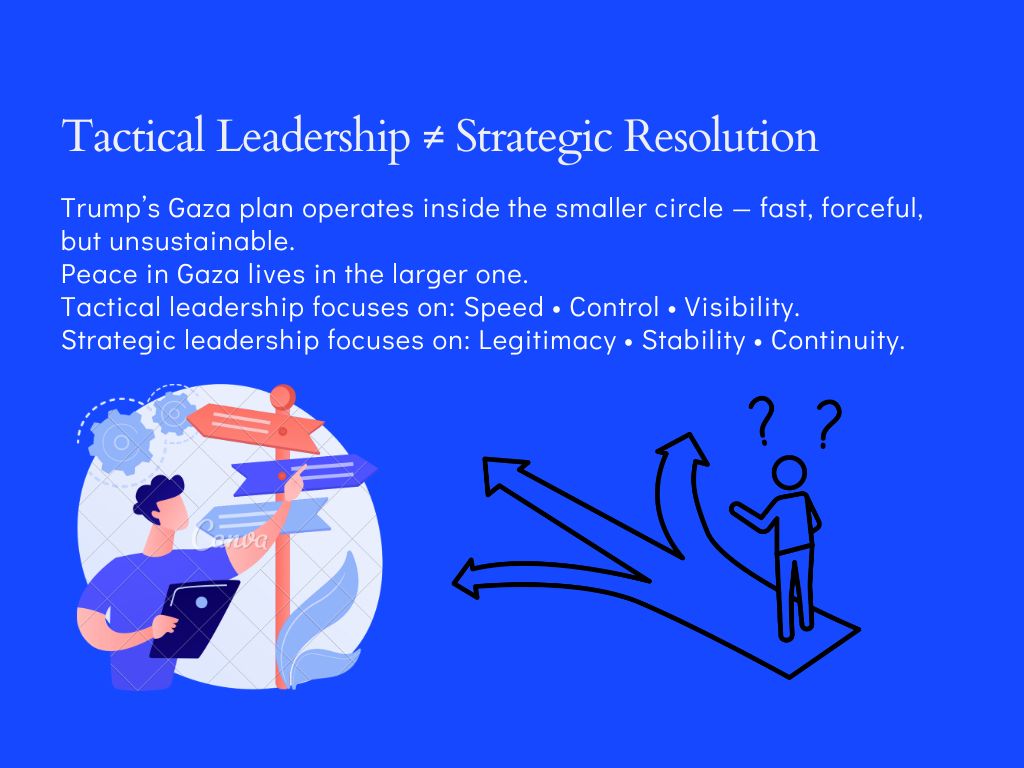
Trump’s new Gaza deal is a tactical maneuver posing as a strategic solution — a short-term show of dominance in a conflict that can’t be solved by force or deadlines.
1. The Context: What Trump Is Proposing
Trump’s proposal includes several highly publicized components:
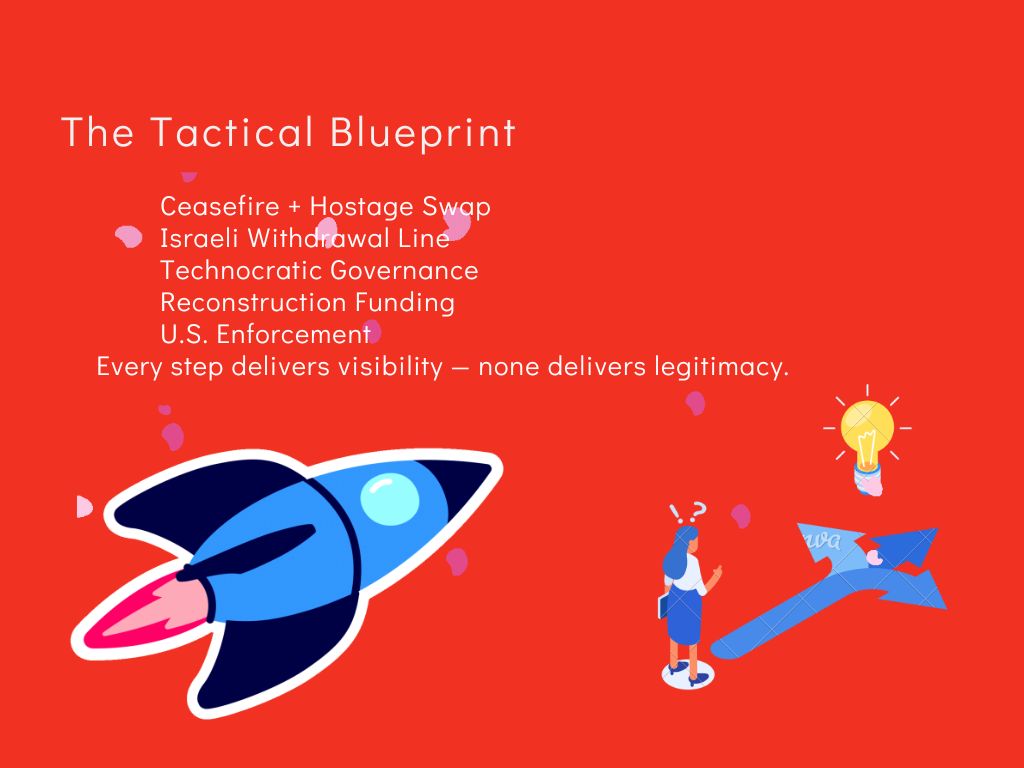
- Ceasefire-for-hostages formula: Israel commits to a defined “withdrawal line” once Hamas confirms prisoner exchanges.
- Demilitarization and transitional rule: Hamas is to be replaced by a technocratic administration backed by international guarantees.
- Reconstruction conditionality: U.S. and Gulf funding tied to compliance.
- Tight deadlines and coercive diplomacy: Accept within days or face “total destruction.”
At first glance, this looks assertive and pragmatic. The logic is transactional: deliver security and humanitarian relief through deal-making efficiency.
But this model assumes that the Gaza conflict is a technical crisis to be managed, not a structural conflict to be transformed.
2. The Analytical Problem: Tactics Without Strategy
Trump’s model falls into a recurring pattern of tactical dominance: use leverage to impose compliance and produce an immediate, visible result.
This approach may temporarily silence guns, but it rarely produces enduring political order.
Three fundamental contradictions expose why:
a. Power Without Legitimacy
In every sustainable peace process, legitimacy matters more than leverage.
- The 1998 Good Friday Agreement in Northern Ireland succeeded because both sides recognized each other’s political legitimacy.
- Oslo, however flawed, worked temporarily because Israelis and Palestinians co-authored it.
Trump’s deal, by contrast, was drafted almost entirely in Washington. Hamas and most Palestinian political factions were not at the table.
Imposed agreements without shared authorship tend to generate temporary compliance and eventual defiance — the same dynamic that doomed U.S. attempts at nation-building in Iraq and Afghanistan.
Argument: When one side dictates the terms, the other side has no stake in preserving them.
Without legitimacy, enforcement becomes the only governing principle — and enforcement erodes over time.
b. Deadlines and Threats in a System That Operates on Identity
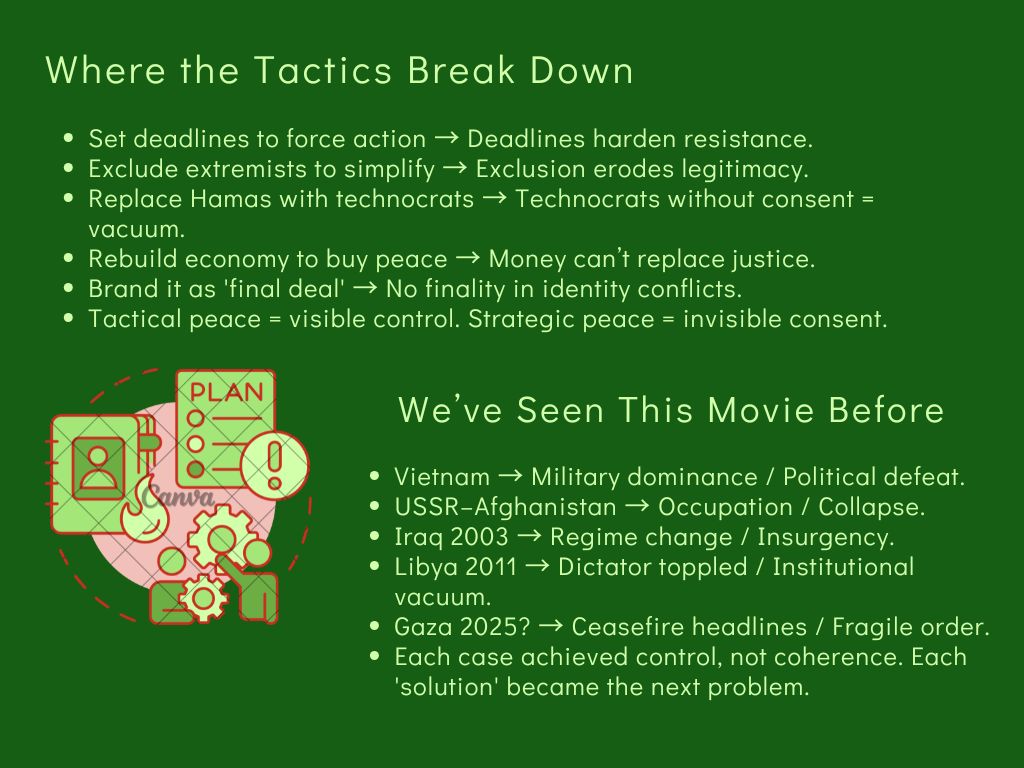
Trump’s ultimatum-driven diplomacy — “accept by Sunday or face annihilation” — assumes that Hamas behaves like a rational actor maximizing short-term gain.
But movements rooted in identity and ideology operate under different incentives: survival, symbolism, and resistance.
Empirical studies of asymmetric conflicts (see Walter, Civil Wars, 2017) show that coercive deadlines in identity-based wars often harden positions rather than soften them.
Argument: Coercive timing may accelerate decision-making, but it decelerates transformation.
Trump’s style achieves speed at the expense of sustainability.
c. Economic Leverage Without Moral Architecture
Trump’s promise of U.S. and Gulf-funded reconstruction mirrors the “Marshall Plan for Gaza” narrative — using capital as peace currency.
But data from World Bank and RAND studies show that reconstruction aid without governance reform merely amplifies dependency and corruption.
In postwar Lebanon, billions in reconstruction funds produced urban growth without institutional integrity; militias simply taxed the recovery.
Argument: Economic relief cannot substitute for justice or political recognition.
Trump’s deal treats reconstruction as compensation, not as restoration of dignity — a distinction that determines whether peace lasts or implodes.
3. The Historical Pattern
Trump’s proposal is not an anomaly. It belongs to a lineage of Western interventions that confuse momentary control with strategic resolution:
| Case | Short-term “win” | Long-term outcome |
|---|---|---|
| Vietnam (1960s-70s) | Military dominance; peace accords. | Political defeat; loss of legitimacy. |
| USSR in Afghanistan (1980s) | Occupation and puppet governance. | Collapse of state and regime. |
| U.S. in Iraq (2003-) | Regime change. | Fragmented order, enduring insurgency. |
| NATO in Libya (2011) | Removal of dictatorship. | Institutional vacuum, chronic instability. |
Each case demonstrates the same sequence: tactical execution → initial control → legitimacy gap → long-term erosion.
Conclusion from evidence: Tactical victories create strategic liabilities when the political system beneath them lacks ownership, justice, and continuity.
4. Trump’s Leadership Pattern: Consistent, Predictable, and Misaligned
Trump’s approach to Gaza is not an outlier — it is an extension of his governing psychology.
He treats politics the way he ran casinos and television shows: as contests with clear winners, visible outcomes, and constant applause.
This produces what political psychologist Jerrold Post calls “transactional narcissism” — leadership driven by the need for dominance and validation, not durability.
The effect on policy is measurable:
- Short horizon: narrow focus on immediate optics.
- High volatility: decisions reversed if applause fades.
- Low predictability: allies uncertain; adversaries exploit inconsistency.
In game theory terms, this is a leader stuck in one-move logic — maximizing the next payoff, not the next generation.
5. The Strategic Lens: What a Real Peace Architecture Requires
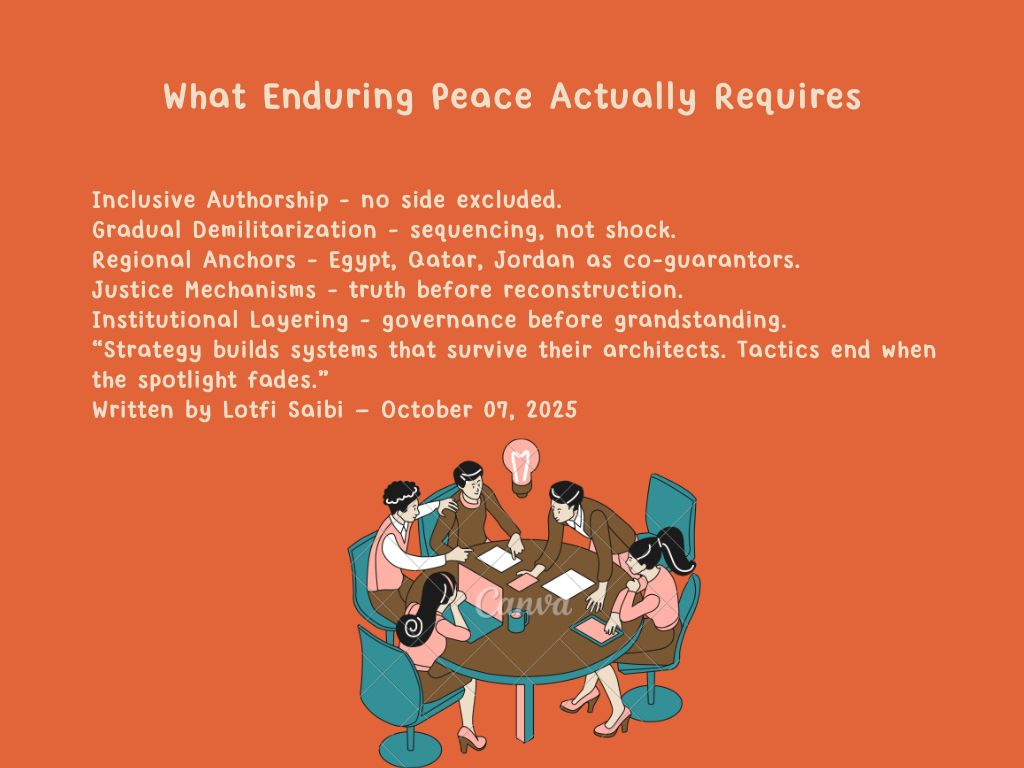
If we evaluate Gaza as a strategic ecosystem rather than a tactical crisis, five prerequisites emerge — all absent from Trump’s plan:
- Inclusive authorship: all political currents represented, even adversarial ones.
- Gradual demilitarization: sequencing, not shock therapy.
- Regional integration: Egypt, Jordan, and Qatar as co-guarantors, not spectators.
- Justice mechanisms: credible international or local inquiry into war crimes to anchor accountability.
- Institutional layering: security, judiciary, local governance built in tandem — not outsourced to foreign administrators.
These are not idealistic conditions; they are empirical necessities drawn from post-conflict transitions that worked (Bosnia’s Dayton Accords, Colombia’s FARC process).
Each succeeded because they created a system, not a show.
6. Data and Early Indicators
- Public sentiment: Early polling by Arab Barometer (Sept 2025) shows only 8% of Palestinians trust any U.S.-brokered framework, down from 27% in 2020.
- Regional diplomacy: Egypt and Qatar have both voiced “conditional support,” signaling skepticism about feasibility.
- Conflict trendlines: According to UN OCHA data, ceasefire violations in previous U.S.-brokered truces spike within 10–14 days when one side perceives the terms as imposed.
These data points suggest that, even if Trump’s deal produces a temporary lull, the probability of relapse is high unless legitimacy and inclusivity are structurally embedded.
7. Conclusion: Tactical Success, Strategic Regression
Trump’s Gaza initiative may secure a short-lived ceasefire or a symbolic hostage release.
But without legitimacy, inclusivity, and accountability, it is structurally unsustainable.
It reinforces the illusion that power can replace politics, and that coercion can manufacture cooperation.
The deeper lesson is not about Trump alone — it’s about the persistent Western temptation to mistake visibility for vision.
Every “quick win” in the region has come with an invisible cost: the erosion of moral authority, the corrosion of trust, and the repetition of the same cycle under a different name.
Real strategy builds systems that survive their architects.
Tactics, however grand, end the moment the spotlight fades.





 Leadership Challenges of the 21st Century