
Leadership is often treated as something that can be developed in a room.
Organizations design programs, schedule workshops, and bring leaders together for a few days of structured learning. The content is relevant, the discussions are engaging, and the feedback is usually positive. Participants leave with new insights, a shared vocabulary, and a sense of progress.
And yet, once they return to their roles, very little changes.
This is not because the workshops are poorly designed. Many of them are thoughtful, well-structured, and professionally delivered.
The issue lies in what they are expected to achieve.
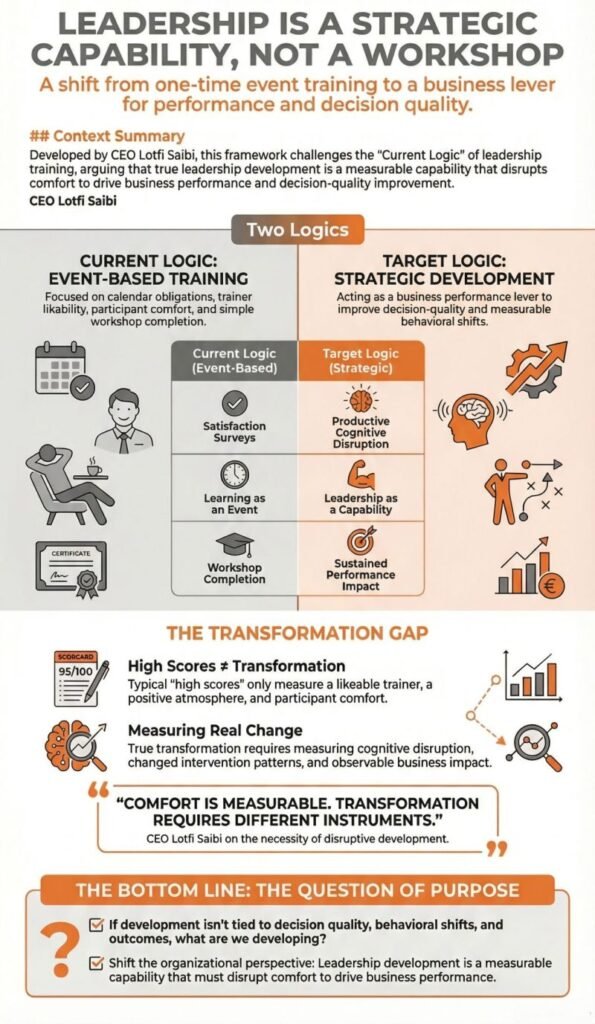
Workshops can create clarity. They can introduce useful frameworks and help leaders reflect on their role. But they operate outside the conditions in which leadership is actually exercised. They take place in environments where decisions carry no real consequences, where tensions are temporarily suspended, and where complexity is simplified.
Leadership, however, does not exist in those conditions. It exists in situations where decisions are not clear, where interests are not aligned, and where each choice has implications that extend beyond the moment. It exists in organizations where formal structures coexist with informal dynamics, where what is written is not always what is done, and where progress depends as much on judgment as it does on intent.
This is where the gap begins.
Most organizations evaluate leadership programs based on the experience they provide. They measure engagement, satisfaction, and perceived relevance. They look at how participants felt, how much they enjoyed the session, and how well the content was delivered.
These are not meaningless indicators. But they are often mistaken for evidence of impact.
Comfort is not a proxy for growth.
A well-received workshop can create a sense of clarity without altering how leadership actually operates. Participants may leave with stronger convictions about what should be done, yet find themselves acting in the same way once they return to their environment.
Not because they lack understanding, but because the conditions in which they act have not changed.
Leadership is shaped less by what people know than by the systems in which they operate.
How decisions are made, how responsibilities are defined, how information circulates, and how accountability is enforced — these elements structure behavior in ways that no workshop can override on its own.
If these elements remain unchanged, leadership behavior tends to remain unchanged as well.
This is why many leadership initiatives produce limited results. They increase awareness, but do not shift the underlying patterns that drive action.
The challenge, then, is not to improve workshops. It is to rethink what leadership development requires.
Workshops can play a role, but they cannot be the core mechanism through which leadership is built. They are moments of reflection, not engines of transformation.
What builds leadership is exposure to situations where:
– decisions must be made under uncertainty
– competing priorities must be reconciled
– and the consequences of action are visible
It is in these situations that leaders are required to move beyond understanding and into judgment.
A capability is not something that can be transferred. It is something that must be demonstrated.
Leadership becomes a capability when individuals are able to:
– read situations accurately
– decide where to act
– and take responsibility for outcomes
This cannot be developed in isolation from the system in which those actions take place. This is where a shift is required. Not from training to better training, but from training to capability. From focusing on what leaders should know, to focusing on how leadership actually functions inside the organization. From designing experiences that feel meaningful, to creating conditions that require different behaviors.
When this shift does not happen, workshops remain disconnected from reality. They provide clarity, but not change. They create alignment in the room, but not in the system. They improve understanding, but not outcomes.
Leadership does not improve because people understand more. It improves when:
– decisions are made differently
– behaviors shift
– and the system begins to support those changes Until then, workshops remain what they are: moments of clarity, separated from the conditions where leadership truly matters.