
Leadership is a System, Not a Skill
Organizations tend to approach leadership as an individual capability. They invest in training, coaching, and development programs designed to improve how leaders think, communicate, and act. The underlying assumption is simple: if individuals become better, leadership will improve. This assumption is appealing. It is also incomplete.
In many organizations, despite sustained investment in leadership development, familiar issues persist. Decisions take longer than they should. Alignment appears present, yet breaks under pressure. Performance fluctuates without a clear explanation. In response, more development is introduced—more programs, more frameworks, more effort.
And yet, the patterns remain.
This is not because leaders are unwilling to improve, nor because development efforts lack quality. The difficulty lies elsewhere. It lies in the way leadership itself is understood.
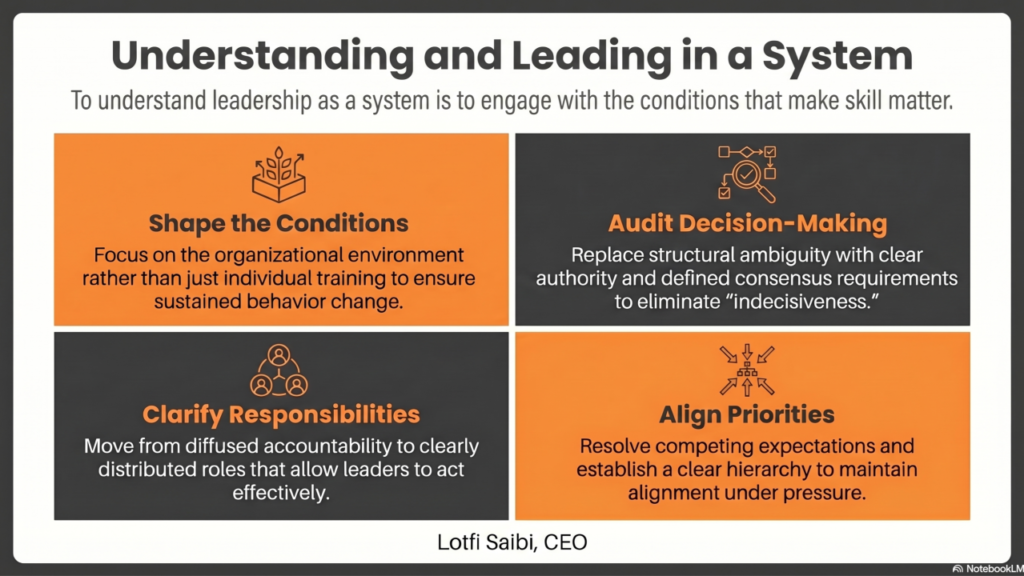
Leadership does not exist in isolation. It does not operate independently of the environment in which it is exercised. It takes shape within a set of conditions that define how decisions are made, how responsibilities are distributed, how priorities are established, and how accountability is enforced. These conditions form a system, and it is within that system that leadership either becomes effective or remains constrained.
When these elements are clear and coherent, leadership tends to stabilize. Decisions are made with greater consistency, alignment becomes more tangible, and execution follows with less friction. When they are not, even capable leaders struggle to act effectively. The issue is not a lack of skill, but the context in which that skill is expected to operate.
This is where many organizations misdiagnose the problem. They observe the symptoms—delays, misalignment, inconsistent performance—and attribute them to individual gaps. Leaders are asked to be more decisive, more aligned, more effective. Development initiatives are expanded in the hope that stronger individuals will produce better outcomes.
But the system in which those individuals operate often remains unchanged.
As a result, behavior tends to revert. Not because leaders disregard what they have learned, but because the environment continues to shape their actions in the same way. Decisions still require informal alignment before they can be made formally. Responsibilities remain diffused, making accountability difficult to establish. Priorities continue to compete without a clear hierarchy. Under these conditions, the expectation that individuals will behave differently becomes difficult to sustain.
The limits of this approach become particularly visible when examining how decisions are made. In many organizations, delays are interpreted as a lack of decisiveness. Leaders are encouraged to move faster, to take ownership, to commit. Yet a closer examination often reveals structural issues. Authority may be distributed without clarity, requiring consensus that is not formally defined. Different stakeholders may hold competing expectations, making any decision difficult to maintain over time. In such contexts, hesitation is not simply a personal trait; it is a rational response to ambiguity.
The same dynamic appears in the way performance is managed. When results fall short, the response is often to increase pressure—tighten targets, reinforce accountability, demand greater discipline. Sometimes this produces temporary improvement. More often, it leads to cycles of effort and frustration, where increased intensity does not translate into sustained results. What is treated as a performance issue frequently reflects deeper inconsistencies in how the organization operates: unclear priorities, misaligned incentives, or decision processes that do not support execution.
Seen from this perspective, performance is not an isolated outcome. It is the expression of a system. It reflects how decisions are made, how trade-offs are handled, and how alignment is maintained over time. Focusing exclusively on results risks overlooking the mechanisms that produce them.
This is why efforts centered solely on developing individuals tend to produce limited and often temporary effects. They enhance awareness and provide useful language, but they do not alter the conditions that shape behavior. Leaders may leave development programs with a clearer understanding of what should be done, yet find themselves operating within the same constraints once they return to their roles. Over time, behavior realigns with the system, not with the content.
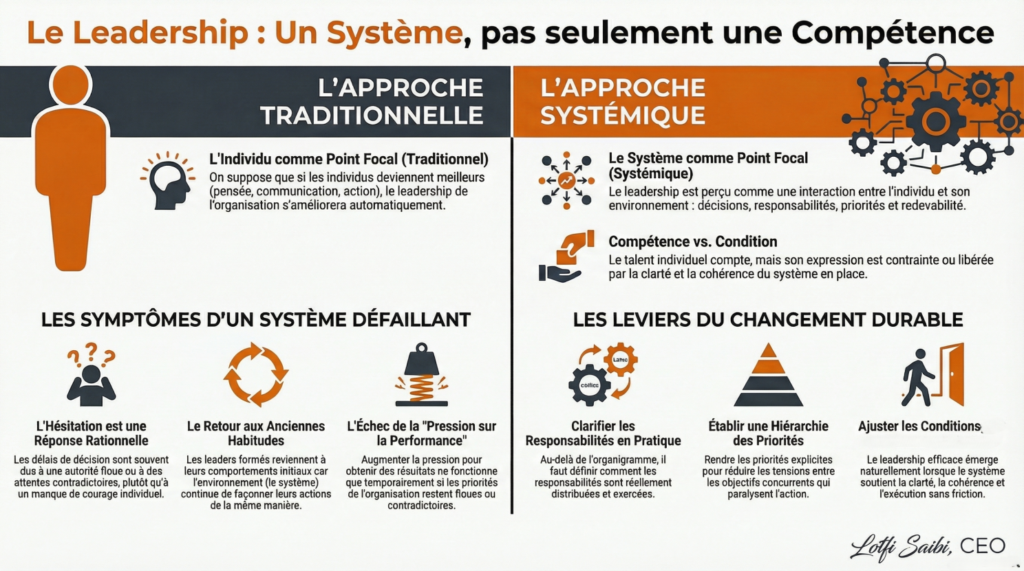
Recognizing leadership as a system does not diminish the importance of individual capability. It places it in context. Skills matter, but their expression depends on the environment in which they are applied. A capable leader operating within a misaligned system will face the same limitations as others. Conversely, when the system supports clarity and coherence, leadership becomes more consistent across individuals.
This shifts the focus of leadership development. The question is no longer only how to strengthen individual capability, but how to shape the conditions in which leadership is exercised. It requires examining how decisions are actually made, not only how they are intended to be made. It involves clarifying responsibilities in practice, not just in structure. It calls for making priorities explicit and addressing the tensions that exist between them.
Such work is less visible than training programs and less easily packaged. It does not produce immediate feedback scores or clear completion milestones. But it is where meaningful change occurs.
Leadership, in this sense, is not something that can be installed through a program. It emerges from the interaction between individuals and the system they are part of. When that system is coherent, leadership becomes more effective. When it is not, even well-developed individuals struggle to produce different outcomes.
To treat leadership as a skill alone is to focus on one part of the equation. To understand it as a system is to engage with the conditions that make that skill matter.
And it is at that level that leadership begins to change in a way that is both visible and sustained.